
Hereditary peers to go - this must be just the start
Let’s start with the obvious - hereditary peers have no place in a democratic Parliament. We’re glad that they’re going.
It is bizarre to think that until 1958, the House of Lords was made up almost exclusively of hereditary peers. The only exception being a small number of bishops and law lords.
And nearly 40 years after the first female MP was elected in 1919, the upper house was exclusively male.
The introduction of life peerages started (slowly!) to change the House of Lords from 1958 on, yet another 40 years on in 1999, hereditary peers still made up 59% of the house.
The size of the House of Lords had grown to nearly 1300 members even though the House of Lords Chamber only has room for 400 to sit. In 1999, the House of Lords Act was supposed to finally remove all hereditary peers, but the Blair Labour Government was forced into a compromise that allowed 92 hereditary peers to stay on ‘temporarily’.
That temporary arrangement has lasted nearly 27 years.
Even when the current Government brought forward its plans to remove the 92 hereditary peers (that it had included in its manifesto), the bill faced determined opposition in the House of Lords. It took another compromise to overcome Conservative peers’ opposition - this time the price was 15 extra life peerages that seem likely to be handed to some of those hereditary peers who are being expelled.
You just can’t get rid of them all!
But we’ll take it, the 1999 reform of the House of Lords is finally complete. So maybe now we can get onto what a second chamber should look like in a 21st century democracy?
Because bluntly, the reform that started in 1999 was at least 100 years late.
A second chamber that relies on the patronage of modern day Prime Ministers through life peerages is hardly a giant leap forward over the descendants of men given hereditary peerages hundreds of years ago!
The strength and the venom of the opposition to the most basic reform to the Lords is hardly likely to encourage the Government to go further.
Here’s some examples of what was said -
Lord Strathclyde called it a “thoroughly nasty little bill”
Lord True said it was a “bitter pill” and that “April will be a cruel month”
The Earl of Devon said his family had been represented in the Lords for 900 years, that “symbols of the hereditary principle that has existed for a millennium” and, most notably, “I believe that this House, Parliament, and the broader public will miss us.”
Totally delusional.
It was the political establishment and entitlement at its worst.
Hereditary peers are going, but the Earl of Devon might still get one of those life peerages handed out as a consolation prize?
Perhaps he then will lead a public campaign to restore hereditary peers to the Lords?
Change in British democracy is hard. Even something as obvious and popular as removing the lawmaking powers of hereditary peers takes decades to achieve.
The British political establishment is deeply resistant to change. It remains reluctant to trust the people with more power. We see this on the House of Lords and we’ve also seen it on the Government’s attempts on devolution which have been massively delayed. There’s been a deep reluctance to use citizens’ assemblies and to solve the glaringly obvious problem with our electoral system too.
For so long, the argument from the establishment could be summed up as ‘if it ain’t broke, don’t fix it’. In 2026 that argument collapsed. Trust in politics is at an all time low. For a country that’s often been seen as a small ‘c’ conservative country, recent polling shows the people divided between massive change and some change - with barely any support for the status quo.
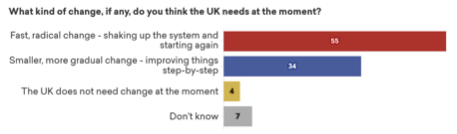
More in Common September 2025
With this in mind, it’s no surprise to see Reform UK and the Green Party both regularly polling higher than both the Conservative and Labour parties which have dominated British politics for a hundred years.
Change is in the air.
A political establishment that’s trying to defend arcane 19th century institutions needs to understand that. A Government that feels that it’s had its fingers burned from trying even the most basic reform of the Lords needs to understand it too.
Now is the time to raise ambition levels - let’s create a modern democracy fit for purpose and able to tackle the problems faced by citizens. We can start with a voting system that delivers what voters want, a democratic second chamber and genuine devolution of power to communities.
Voters are clamouring for nothing less.
© House of Lords 2024 / Photography by Annabel Moeller