
The Election Denial playbook: we don’t want to see that here
It’s nearly six years since President Trump lost the 2020 elections and yet he maintains the election was rigged.
There is no credible evidence of this being true. It’s been investigated by Trump’s own government and not a shred of wrongdoing has been found. But that’s not stopped confidence in US elections falling.
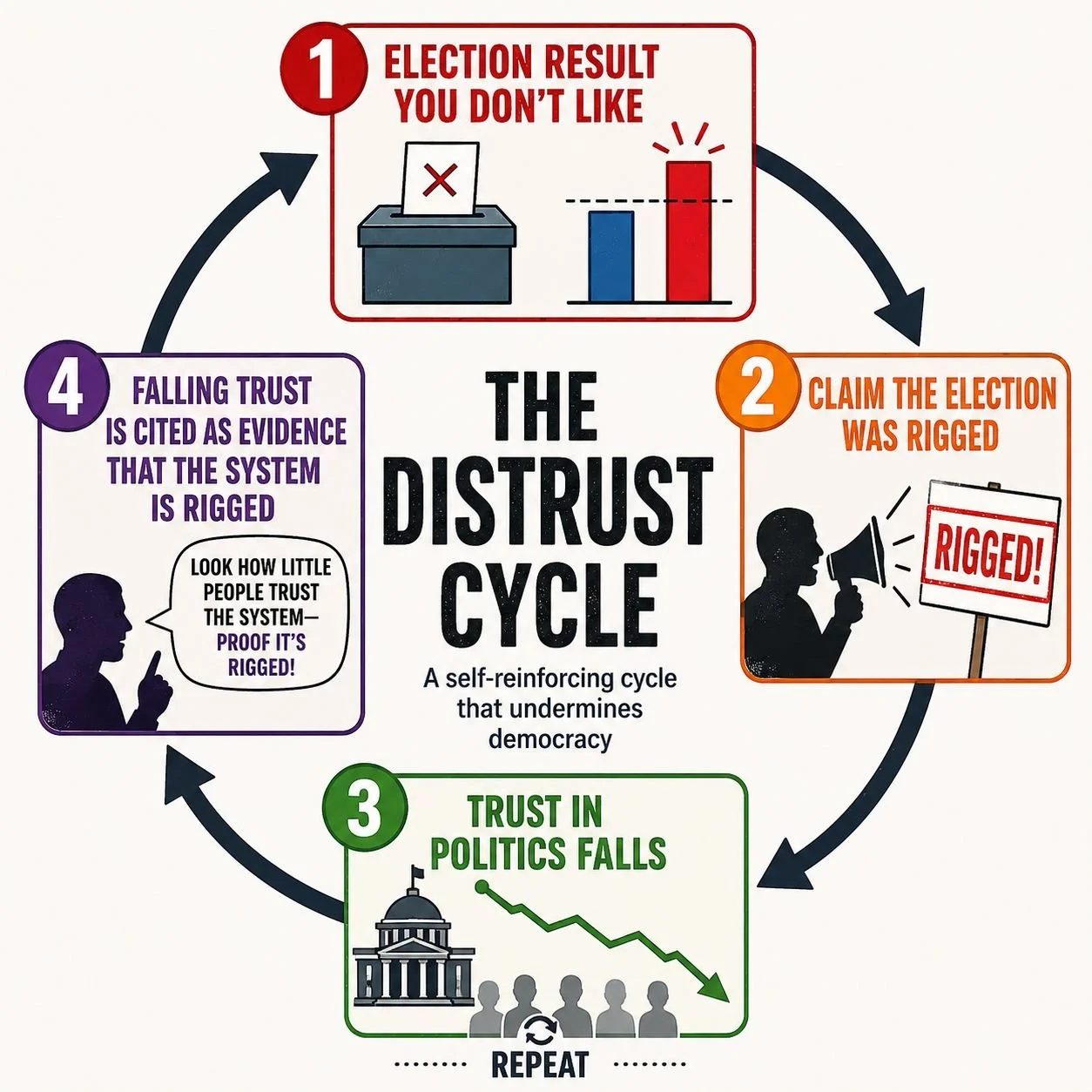
Trump has deliberately created a distrust cycle that’s undermining democracy - all because he couldn’t take the fact he had lost.
Six years on Trump is claiming another election has been rigged, this time in California.
Again there’s no evidence of this - once again the driving factor is that the President doesn’t like the outcome of a fair election.
And so the distrust cycle begins again - except this time, distrust in elections is already higher because of Trump’s baseless claims about the 2020 elections.
Which in turn means distrust becomes more and more corrosive to American democracy.
And let’s not forget the political violence Trump’s election claims led to on January 6th. That must never happen again.
But despite all this, election denial seems to have been ‘good politics’ for Trump. Firstly, rather than having to confront his loss and the reasons for it, he can change the debate - I didn’t lose, I won and the system was rigged against me.
Secondly, it plays with the ‘there’s no smoke without fire’ idea that most people are inherently likely to believe - but in this case, the smoke doesn’t point to a rigged election, but to the person who lost that election and is trying to hide that fact.
This won’t work for every politician, but no one can deny it’s worked for Trump.
That’s why he’s sticking to it.
So no one should be surprised if other politicians opt for a copycat approach.
A potential sign of this in the UK was the recent Manchester Gorton and Denton by-election - comfortably won by the Green Party.
In this case, Reform UK and its defeated candidate Matt Goodwin stopped short of a full on Trump-style defence. They didn’t question the vote count like Trump did, but they did say the result was a ‘victory for sectarian voting and cheating’.
Their message was that in a fair fight they’d have won. The fact is, it was a fair fight (the Police found no evidence to the contrary), and they lost.
The close links between Nigel Farage and Donald Trump are no secret. Back in 2020, Farage initially seemed to back Trump’s claims of voter fraud, before later backing away.
Now it seems Reform UK are again learning lessons from Trump’s America. Their reaction to the Makerfield by-election result, if it hasn’t gone their way, will establish whether Gorton and Denton was a one off.
Trust in the democratic process is a precious thing.
It’s something that historically all the players in the political system have sought to maintain. After all, if you hope to win, you don’t want anyone to put that down to a crooked election!
Given that the World Cup is on, a football analogy seems apposite. When you lose a football match, you can blame the pitch, the referee, your opponents, your luck or even the weather - but no one queries the score. A 1-0 defeat is a 1-0 defeat.
But in Trump’s world, you question everything.
That’s different and new and it’s a dangerous, dangerous thing for democracy.