
Do young people care about politics?
By Araoluwa Aina, work experience student at Unlock Democracy.
The Representation of the People Bill will soon give 16 and 17-year olds across the United Kingdom the right to vote in all elections. The government hopes this will engage voters at a young age, helping to build the foundations for lifelong participation in elections.
The Bill has sparked debate on youth participation in politics and whether young people care about politics at all.
The myth of youth apathy
Young people in the UK tend to have lower voter turnout than older age groups. In the last General Election, fewer than half of 18 to 24-year-olds voted.
This has fed the myth that young people are politically apathetic and are not interested in participating in democracy. That couldn’t be further from the truth. The reality is that the majority of young people recognise the importance of politics, with 81% of young people considering it important to live in a democracy.
From my personal experience as a Sixth Form student, I believe that young people in the UK are interested in politics and follow political issues affecting the UK and other parts of the world, such as the USA and Middle East.
However, many young people feel that mainstream political figures don’t care about young people’s issues. A poll by the UK Youth Poll showed that 46% of young people believe that they don’t get a fair hearing in UK politics. When asked what stops them from being more active in politics, only 9% of respondents claimed they don’t care about politics and community affairs. 30% answered that they don’t trust politicians and 27% answered that politicians don’t listen to young people. This demonstrates that young people do care about politics, but don’t feel represented and listened to by politicians, and so they are less likely to be politically active in a traditional manner.
How do young people engage in politics?
A recent report from the Institute for Public Policy Research (IPPR) explored youth politics and democratic renewal in Britain. This report concluded that the crisis in youth participation in politics is alienation, not extremism or apathy, as is often assumed.
Through empirical analysis, they found that today, young people have a different experience with politics than the generations that came before them.
Categorised by political historian Anton Jäger’s term “hyper-politics”, politics today is marked with rapid cycles of mobilisation and engagement, high issue salience, and is centred around specific causes rather than long-standing institutions. For example, young people care deeply about specific issues such as climate change and global conflict, but this does not always translate into engagement with democratic institutions.
Social media platforms are another reason why youth political participation looks different from older generations. Young people cite social media as the most common place they encounter political information and that affects how they engage. For example, social media allows for fast and direct mobilisation for socio-political causes in non-traditional ways, such as creating campaign TikTok videos that go viral.
TheUK Youth Poll reflects this different mode of political participation. It found that nearly 75% of young people have engaged in some form of political activity when defined broadly, but this figure falls sharply when focusing on organised politics. Only 6% of young people have done any work on behalf of a political party, organisation or cause, but 33% have signed a petition and 27% have used social media to advocate for an issue.
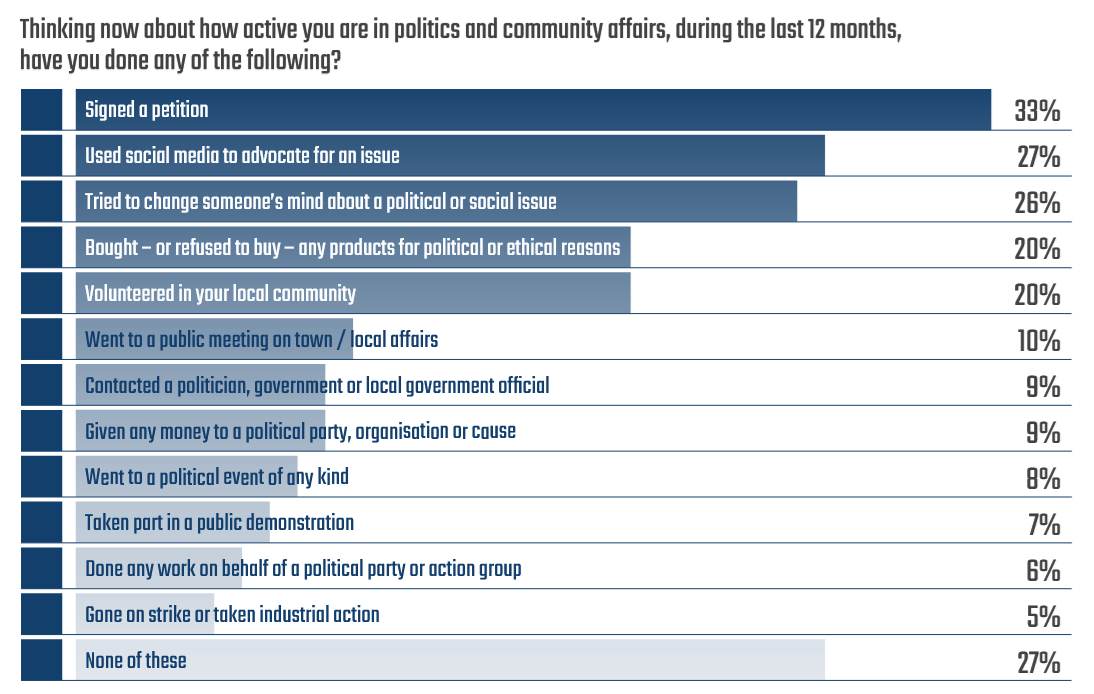
This makes clear that while young people disengage from traditional political participation, this does not mean they’re apathetic, they just engage differently. The IPPR report calls this the youth engagement paradox, defining it as young people’s “high political interest and issue-based engagement, combined with deep scepticism about the value of formal democratic participation”.
Turning engagement into participation
Moving forward, we must encourage young people to vote. Not only do youth voters matter electorally, the political habits formed when you’re young can endure throughout your life. Failing to engage young people in politics risks the health of British democracy in the future.
Politicians can help engage young people in politics by pushing for changes that make young people feel their voices are listened to. They could start by introducing Proportional Representation and Automatic Voter Registration, both of which Unlock Democracy campaigns for.
Proportional representation could help increase electoral participation amongst young people. With the current First Past the Post voting system, some votes are wasted because millions of voters have representatives they didn’t vote for. For example, in the 2024 General Election, 73.7% of votes made no difference to the end result. This unequal voting system adds to the sense of alienation that young people already feel.
That’s why Unlock Democracy is calling for a National Commission on Electoral Reform to look into options for a new, fairer voting system for the UK.
What’s more, Automatic Voter Registration would ensure that all young people are on the electoral register, making voting more accessible for them. It was estimated in 2022 that around 8 million eligible voters aren’t on the electoral register, and young people and students are two of the least likely groups to be registered.
Automatically adding young people to the electoral register is key to making Votes at 16 a success. The Representation of the People Bill will introduce Automatic Voter Registration, but there’s a risk that it won’t be ready until the 2034 General Election! Unlock Democracy wants the government to commit to a timeline for Automatic Voter Registration that will get everyone registered to vote before the next General Election.
Conclusion
Young people in the UK interact differently with politics than older generations. Instead of taking part in traditional organised politics, they often focus intensely on specific issues and take action in non-traditional ways, such as signing an online petition or sharing a viral video on social media.
Young people don’t feel represented or heard by the government and so tend to vote less than older generations.
To solve this, we must make sure that young people feel that their votes actually matter, starting with switching to a more proportional voting system, and ensuring that voting is easier for young people, by implementing Automatic Voter Registration.