
What is Single Transferable Vote?
The Single Transferable Vote (STV) system gives voters the ability to rank candidates in order of preference, while ensuring that the share of seats for each party matches the share of the vote they receive.
STV is already in place for elections in Ireland, Northern Ireland (except at UK general elections) and council elections in Scotland.
Ranking the candidates
The ballot under STV looks quite different, but does in fact share some common features with First Past the Post. Voters choose from individual candidates, not parties. But instead of forcing millions to vote tactically (by voting for a candidate they think can win rather than their favourite) or see their votes count for nothing, voters under STV can rank candidates based on their preferences (1st, 2nd, 3rd, etc). Larger constituencies electing multiple MPs means smaller parties can still get fair representation, and wasted votes are kept to a minimum.
How Single Transferable Vote works
Candidates must achieve a certain level of support - a ‘quota’ - to get elected. This quota is determined by the election authorities, according to the number of valid votes cast and the number of seats to fill.
Once the votes are counted, any candidate with enough first preferences to meet the quota is elected. Surplus votes - that is, those above the quota - are transferred to second preference candidates.
If no new candidate reaches the quota, then the candidate with the fewest first preference votes is eliminated, and their votes transferred to next preferences. This redistribution and elimination process continues until as many candidates meet the quota as there are seats available.
Example
Imagine there are 4 candidates vying for 2 seats. 100 valid votes are cast. The quota required to get elected is 34 votes.
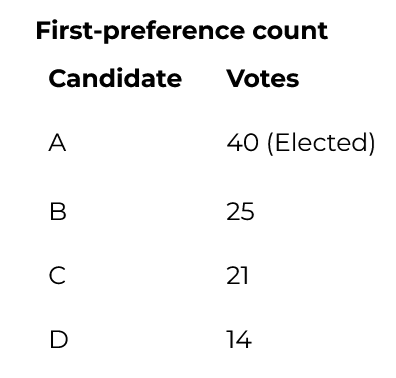
Candidate A has reached the quota, with 6 surplus votes. These surplus votes are then transferred to second preferences. To keep things simple, let’s say all these surplus votes go to Candidate C.
Candidate C receives six second preference votes, taking their total to 27. But that’s still not enough to meet the quota.
Eliminate the candidate with fewest first preferences (Candidate D)
Candidate D's 14 votes now transfer to the next preference. Let’s say they are evenly split between Candidates B and C.
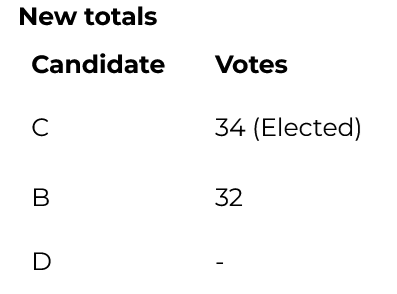
Candidates A and C are elected.
Why is Single Transferable Vote better than First Past the Post?
Unlike First Past the Post, STV helps ensure that parties’ share of seats more closely reflects how people vote. This stops a party from winning a large majority in Parliament based on a small share of the vote.
By allowing voters to express multiple preferences, STV means as many votes as possible have an impact on who gets elected. This means fewer wasted votes than under First Past the Post.
→ Read more about First Past the Post.
What is Unlock Democracy’s view on Single Transferable Vote?
Unlock Democracy believes that Single Transferable Vote is one of several Proportional Representation systems that would make elections fairer and ensure that Parliament better reflects how people vote.
We welcome the National Commission on Electoral Reform which will recommend a voting system fit for the future. It may well consider Single Transferable Vote among other systems.
Read next:
What is the Additional Member System?
What is Proportional Representation?
What is the National Commission on Electoral Reform?