
Why does First Past the Post no longer work?
Supporters of First Past the Post have argued that it produces a two-party system that delivers clear, stable, single-party government and suppresses smaller parties.
But in practice, these supposed advantages have all but disappeared:
1) Collapse of the two-party system
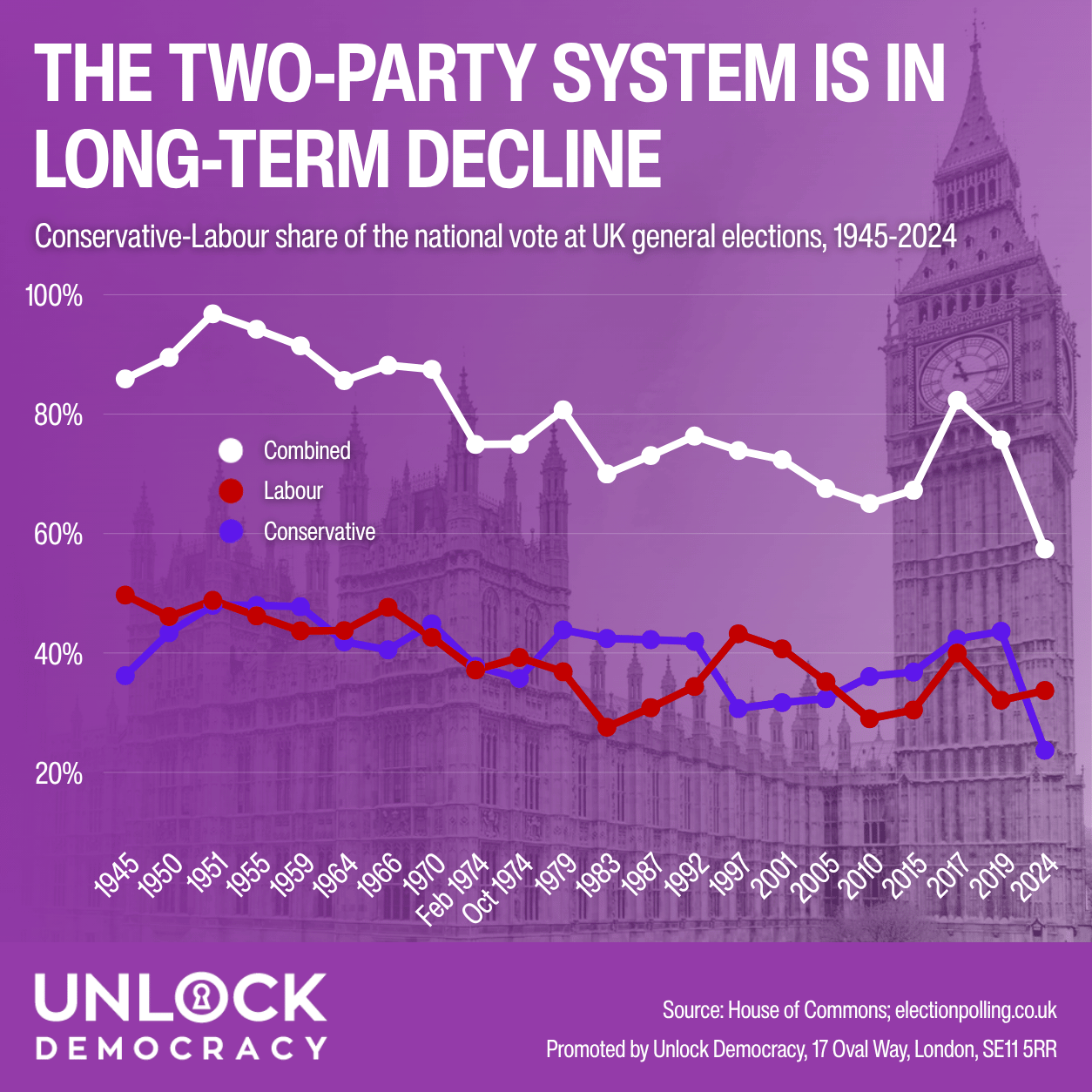
FPTP used to work when we had a two-party system, but for decades now voters have been moving away from the traditional big two parties, Conservative and Labour.
In the 1950s, the average share of the vote won by the two main parties was 93%. By the 1970s, it had fallen to 80%. Fast forward to 2024, and at 57%, Labour and the Conservatives received their lowest ever combined share of the vote.
2) Growth of ‘third’ parties
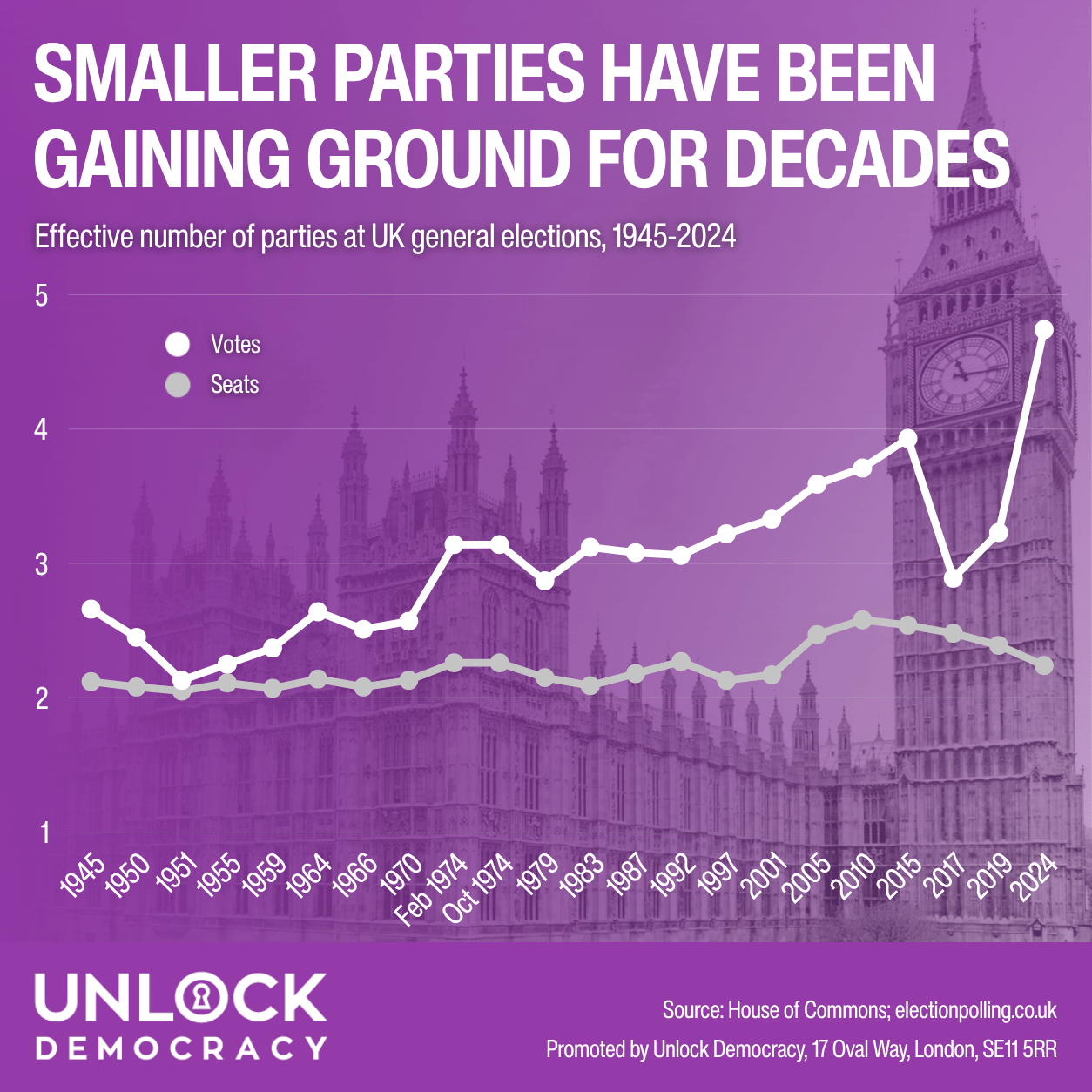
Inevitably, this first trend has given rise to the second: third-party support has grown significantly. For example, in 2010 the Liberal Democrats won 23% of the vote, one of the strongest third-party performances for a century.
As well as individual ‘third’ parties gaining ground, the number of parties gaining a significant chunk of the vote has also increased. For the first time ever, four parties, in 2024, commanded comfortably more than 10% of the vote.
Regional parties, such as the SNP, have also benefited because the system rewards concentrated local support.
As a result, FPTP is no longer reliably suppressing smaller parties, weakening the two-party dynamic it relies on.
3) Fewer ‘big two’ marginals
FPTP’s ability to turn small shifts in the vote into single party majorities depended on many constituencies being ‘big two’ - that is Conservative-Labour - marginals. In the 1950s, around 30% of seats were Con-Lab marginals, allowing small national swings to flip numerous constituencies, as in 1955, when the Conservatives polled 3 percentage points more votes than Labour but gained an 11-point lead in seats.
By 2015, however, only about 13% of seats were ‘big two’ marginals. Even though this figure has since recovered slightly (19.5% at the start of this Parliament), the rise of third parties means the ‘big two’ are directly battling one another in fewer seats than ever. In 2024, in only 47% of seats did Labour and the Conservatives - the top two parties nationally in votes and seats - both finish in the top two.
While it’s true that 115 seats were won by a margin of 5% or less of the total constituency vote, because these are multi-dimensional, split across five parties, national vote swings are outweighed by local dynamics.
As a result, the relationship between changes in national vote share and seats won or lost is far less predictable. FPTP can no longer reliably guarantee the smooth alternation of power, meaning elections are more and more likely to produce hugely distorted results, as in 2024 or 2015, or hung parliaments, like those in 1974, 2010 and 2017.
4) Increasingly disproportional results
As support for the two main parties has declined and more parties have gained ground, FPTP has become worse at translating votes into seats fairly.
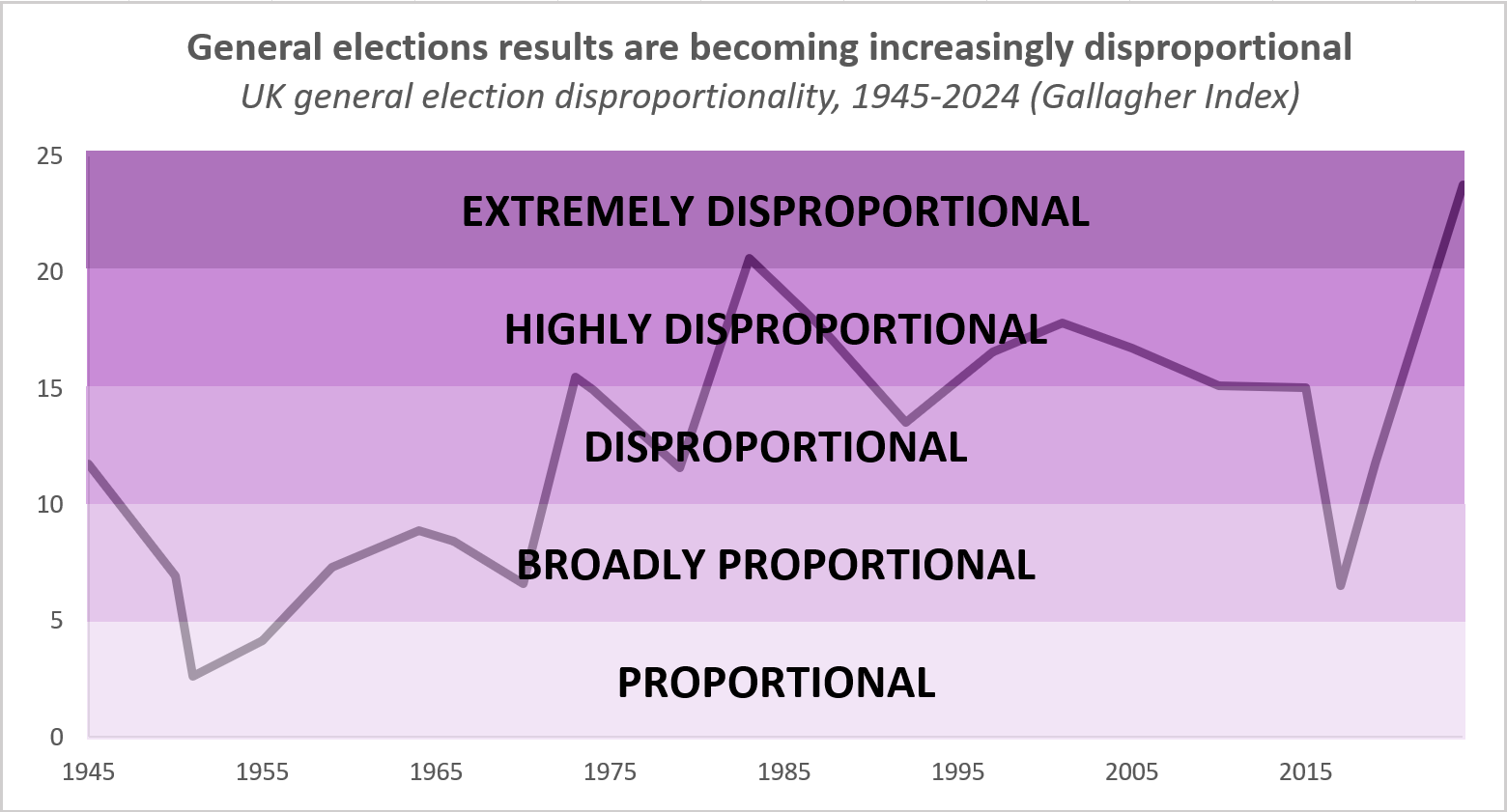
The 2024 general election was the most disproportional in British history, with Labour winning 63.2% of the seats in Parliament on just 33.7% of the vote. This is no coincidence: more voters than ever backing so-called ‘third’ parties, in a system designed for only two parties, is bound to result in an unrepresentative Parliament.
This growing gap between how people vote and how the parties are represented in Parliament is becoming harder and harder to justify.
5) Failure to deliver stable government
The UK has hardly been a model of stability in recent years. Since the 2016 Brexit Referendum, we have had seven Prime Ministers, nine Chancellors, ten Foreign Secretaries and ten Home Secretaries. Across the cabinet as a whole, the post-Brexit period has seen an average of over 11 ministers leave their post each year.
While this kind of instability has intensified since 2016, the UK has long been home to a higher rate of ministerial turnover than most other advanced democracies. Between 1974 and 2023, UK cabinet ministers lasted in post, on average, for only just over two years; PR-using Germany, by contrast, kept its ministers in post for more than 3 ½ years.
As support fragments across more parties, FPTP is driving instability by manufacturing large Commons majorities for parties on historically low shares of the vote. This allows governments to mistake parliamentary dominance for substantial public support. The result is a government that looks secure until even a small dip in the polls puts scores of its seats at risk, shredding its authority within its own ranks as its MPs worry about their futures.
Overall
First Past the Post is increasingly ill-suited to the UK’s changing political landscape, with:
diminishing support for the two main parties
growth in third parties
a more erratic relationship between shifts in vote share and seat changes
increasingly distorted results, and the prospect of more hung parliaments
greater political instability
In other words, the system is no longer delivering the outcomes its defenders promised, while still failing to accurately represent how the country voted.
Read next:
What is Proportional Representation?
What is Single Transferable Vote?
What is the Additional Member System?